Every Herod Will Pass, Every Caesar Will Fade, for Empires Have an Expiry Date
"And let us remember that according to Jesus, it is the meek, not the powerful, who inherit the land."

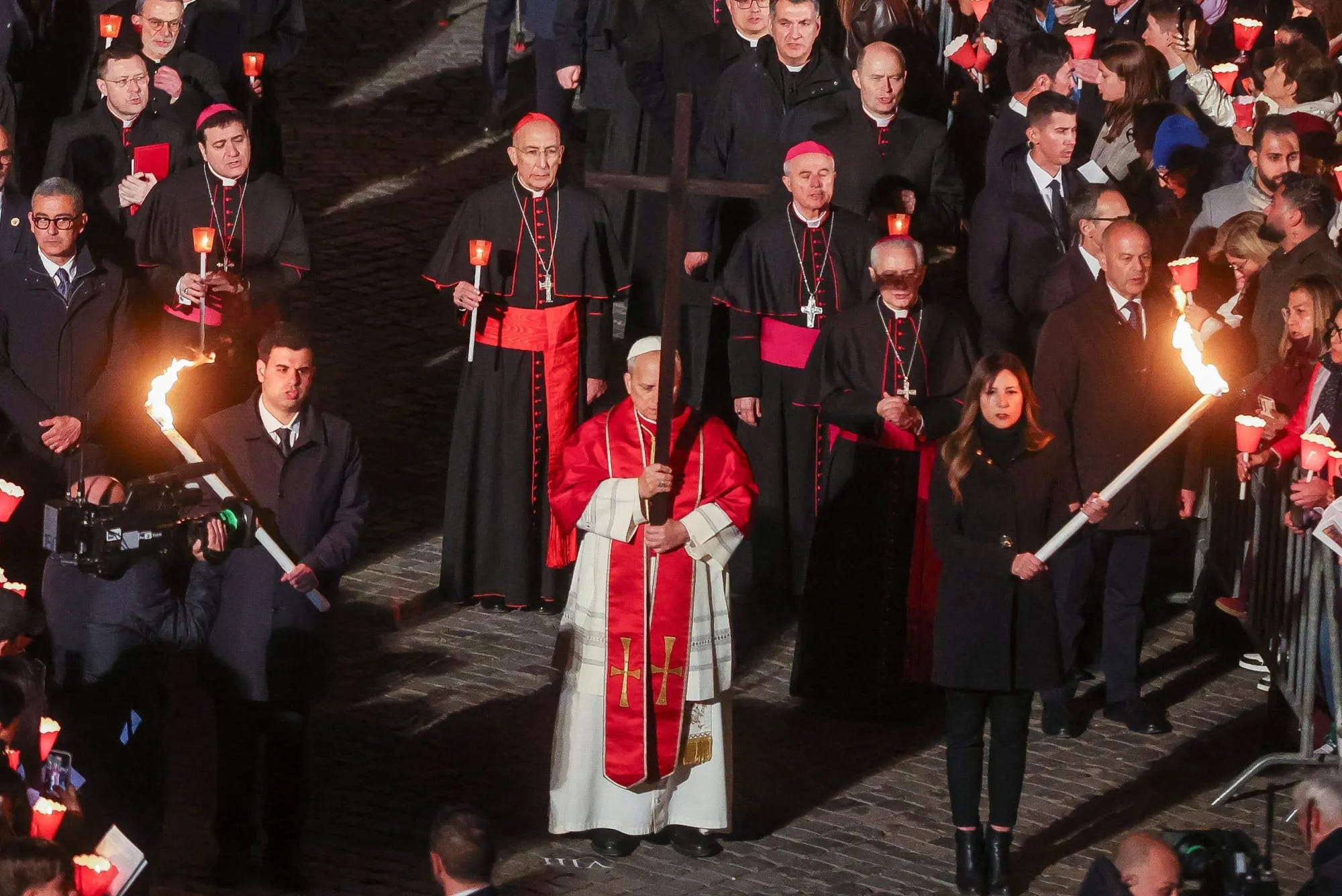
This Friday, on the first Good Friday of his pontificate, Pope Leo XIV entered the Colosseum in Rome to begin the Via Crucis. The new 70-year-old pope decided to carry the cross through all 14 stations of the Way of the Cross, holding it up in front of his face for nearly two hours as he prayed “for victims of war, the defense of human dignity, the despairing, and the lonely.”
A chilling sight, seeing the new Pope walking the Way of the Cross where early Christians were martyred.
Talk about a powerful moment. For Christianity? Humanity?
This marks the first time a pope carried the cross for every station in more than three decades. Pope John Paul II was the last pope to do so, carrying the cross from 1980 to 1994.
When asked about his decision to carry the cross for all 14 stations, Pope Leo told reporters he saw it as a sign the world needed right now:
“I think it will be an important sign because of what the pope represents, a spiritual leader today in the world, for this voice that everyone wants to hear to say that Christ still suffers, and I carry all these sufferings too in my prayer.”
Pope Leo extended an invitation to all people, regardless of faith:
“I would like to invite all people of goodwill, all people of faith, all Christians to walk together, to walk with Christ who suffered for us to give salvation, life, and to seek how we may also be bearers of peace and not of hatred.”
Per OSV News, the meditations for this year’s Via Crucis celebration were written by Father Francesco Patton, who formerly served as custos of the Holy Land and drew on his experience walking the historical Way of the Cross through the narrow streets of Jerusalem’s Old City, describing it in both Jesus’ time and today as “a chaotic, distracting and noisy environment, surrounded by people who share our faith in him, but also by those who deride or insult him.”
Biblical parallel that’s somehow still accepted in 2026.
In this way, Father Patton said, the Via Crucis parallels how every Christian is called to incarnate faith, hope, and charity in the real world “where the believer faces ongoing challenges and must constantly strive to imitate Jesus.”
Do you see where I’m going with this? I mean, it’s Easter Sunday, the text and the context are practically writing themselves.
What kind of believer are you?
Each of the 14 stations of the Via Crucis Pope Leo walked in Rome’s Colosseum included a Scripture reading, a quotation from St. Francis, a meditation by Father Patton, and a short introspective litany.
Meditation for the first station:
“Jesus is condemned to death,” called leaders of every kind to account, with Father Patton writing that every person in authority will answer to God in the Last Judgment for how they exercise power, including “the power to judge; the power to start or end a war; the power to instill violence or peace; the power to fuel the desire for revenge or for reconciliation; the power to use the economy to oppress people or to liberate them from misery.”
The tenth station:
“Jesus is stripped of his garments,” drew a sharp connection between Christ’s humiliation and contemporary violations of human dignity. The meditations cited authoritarian regimes that force prisoners to remain half-naked in bare cells, torturers who tear away not only clothing but skin and flesh, sexual abusers who reduce victims to objects, and an entertainment industry that “exploits nudity for the sake of profit.”
The meditation concluded with a call to conversion, “Remind us, Lord, that each time we fail to recognize the dignity of others, our own dignity is diminished.”
The eleventh station:
“Jesus is nailed to the cross,” offered a meditation on the nature of true power in the eyes of God. “You show that true power is not that of those who use force and violence to impose themselves, but that of those who are capable of taking upon themselves the evil of humanity — ours, mine — and destroying it with the power of love that is manifest in forgiveness.”
The litany prayers that followed each meditation gave voice to a wide range of human suffering.
The eighth station:
“Jesus meets the women of Jerusalem,” the crowd prayed to “weep over the devastation of war” and “for massacres and genocides.”
OSV News reports that, throughout the evening, prayers were offered for political prisoners, for people searching for the ultimate meaning of life, for those suffering from addiction, for children whose childhoods have been stolen, for victims of trafficking, for the poor stripped of their dignity, for migrants and refugees, for the lonely, for mothers who have lost children and for those who die alone.
This was all lovely. In theory.
I’m a Roman Catholic. I don’t really practice my religion. I dabble in it. If you want to read about my (funny-ish) religious journey, check it out below.
Every Easter, for the past three years, I share the same post on social media with the same caption that says:
Wishing you a blessed Good Friday. Today, your horoscope and your Christian faith tell you to commemorate Jesus’ crucifixion by speaking out on the injustices in Gaza and today’s crucifying of an entire group of people at the birthplace of your favorite religious leader, because that’s the best possible way to honor him, your religion & your beliefs.
This year, I added the bombing of the sovereign state of Iran in an illegal war of conquest and the bombing of civilian infrastructures in Southern Lebanon to my yearly Good Friday post.
Every Easter, this post steers some trouble. People feel called out. And that is my intention. Every Easter or Christmas, when people dial up their Christian sentiments online, those sentiments, I feel, should be confronted with the reality of a live-streamed genocide, occupation, invasions of sovereign countries, and illegitimate wars of conquest filling our screens.
But I mostly do it to provoke religious people into translating their beliefs into actual words and tangible actions, especially now, in the times of unimaginable violence and impunity.
Does your God approve of this?
As I’m writing this, I took a short break to check my Instagram, and the first thing that filled my screen was two stories posted by a friend of mine: his favorite uncle, killed by an IDF bomb in a civilian village in southern Lebanon. On Easter morning. Just like that, a life that meant so much to someone, gone within minutes. Because people who already have land need more land. My heart sank.
What do you say to someone directly affected by the biblical prophecy of the cult next door?


Every year, I share my Easter post to see how people respond, how believers react, and whether anything changes — to see whether the scale of carnage we’ve been witnessing will move those who remain unmoved by the annihilation of people far away, people who don’t look like them or pray like them.
I’ve been busting my brain for the past three years trying to understand how a religious person can witness this level of suffering, carnage, death, torture, rape, dehumanization, man-made starvation, and medieval brutality, and remain unmoved. Or worse, justify it.
And I came up with nothing but — exceptionalism.
Religion, at its core, is sold to us as a belief rooted in principles of compassion, humility, and service to the oppressed and the less fortunate. Yet exceptionalism, by its nature, fosters superiority and exclusivity, making it an oxymoron when paired with the teachings of most religious doctrines.
So why do they go hand in hand so seamlessly? Why do so many religious people find themselves caught in a sense of exceptionalism, the belief that their faith or cultural identity places them above others?
A weapon.
This contradiction is precisely what turns a tool for unity into a force of division, and more often than not, into an actual weapon, as we see in Palestine, Lebanon, Iran, and across Africa.
Are people too naive to think this tension highlights how religious identity, when warped by exceptionalism, has strayed too far from its intended purpose? Or has this distortion always been a central feature of religion, wielded throughout history as a shield for those who subjugate others?
As I was breaking down the relationship between religion and exceptionalism for this piece, I came across an interview with George Galloway that filled in the gaps for me. George, as always, hits the mark:
“I honestly can’t understand how anyone can look at the pictures and videos that I’m looking at (carnage in Gaza) and come to any other conclusion, unless you believe in exceptionalism, unless you believe that some of us are more exceptional than others, some of us are chosen, therefore some of us by definition are not. I believe that all of us are God’s children, that none of us are exceptional, that none of us are God’s chosen people, that we are all God’s chosen people. We need to make a world that is fair and equitable.”
Exceptionalism is tricky.
It doesn’t reside solely among the privileged, the successful, the affluent, or the well-connected. It manifests in many forms. I’ve seen it among friends from humble beginnings who still believe that their European heritage, Western ideals, and lifestyle represent what the entire world should aspire to.
Arnaud Bertrand once asked himself if religion is either a legitimizing instrument of power — a crown on its head — or a thorn in power's side, standing with the powerless?
Whether we believe in God or not, we embody something greater, and it’s up to us to define that essence. Are we ready to acknowledge that we are all interconnected as part of the human race, and that nothing we hold dear should take precedence over the well-being of others?
Trump and his gang of criminals, driven by their partner — a biblically deranged cult in the Middle East — have pushed us toward a decade of economic uncertainty, and for those less geographically fortunate, toward death. We will all be affected by this war.
The marriage of religion and exceptionalism must be examined and checked daily, and I am not inclined to entertain those who use “their Christianity” to justify racial supremacy or to deflect from the injustices that sustain their privilege.
Everyone who has been paying attention over the past three years can see how often religion is used to legitimize power. Jesus Christ, whose resurrection is being celebrated today, preached humility, compassion, and care for the marginalized — values that stand in direct opposition to the priorities of modern power structures. Yet his teachings are constantly repurposed and commercialized to serve political agendas, including those that justify or accompany imperial wars.
The fact that the entire planet is now at the mercy of economic and geopolitical collapse, mass death and destruction, and even the threat of nuclear warheads, led by Christian Zionists, which contradicts the core teachings of Christianity, is a tragic consequence of bad theology.
Theological crisis.
Rev. Dr. Munther Isaac, a Palestinian pastor, laid out this theological crisis forcefully in his sermon, “Christ is Still in the Rubble,” live from Christmas Lutheran Church in Bethlehem in Dec 2024. He touches on what has been weighing on all of us: how can religious, church-going Christians stay silent on a live-streamed genocide in Gaza? And even worse, how can they support it?
Bombing civilian villages in South Lebanon and taking their land? Bombing Iran, a sovereign nation, in the middle of the negotiations, twice? Massacring 168 of their schoolgirls? 20 teenage female Volleyball players in a gymnasium? Does their God approve of this?
Key points from his speech worth pondering on:
“This is the result of an exclusionary mentality. Even God, we have made tribal, exclusionary, and selective — a God of one people at the expense of another, one religion over another, one nation over another. In our human racism, we have made God a racist!”
We have made God a racist. Have you ever heard anything so essential?
“Palestine is a human and moral cause, and for the church, it is a theological crisis. It’s about the credibility of our witness; it’s here that we come face to face with the tragic consequences of bad theology. Actually, this is much more than bad theology or even ideology. Zionism and Christian Zionism are ideologies of supremacy; it is racism.”
“Zionism and Christian Zionism turned God into a racist tribal deity of their own image. So we must call things for what they are, and today we also acknowledge all those who stood on the side of justice and truth. All those who said no to dehumanization, many of whom paid the heavy price.”
“Every Herod will pass, every Caesar will fade, for empires have an expiry date.”
“And let us remember that according to Jesus, it is the meek, not the powerful, who inherit the land. In our pain and oppression, we might feel that death has the final word, that Herod is sovereign. But through the eyes of faith, we see that God has the final word.”
If you’re a Christian, does your God approve of this? Be honest with yourself. You’ve seen it all. How can you still justify this?


