

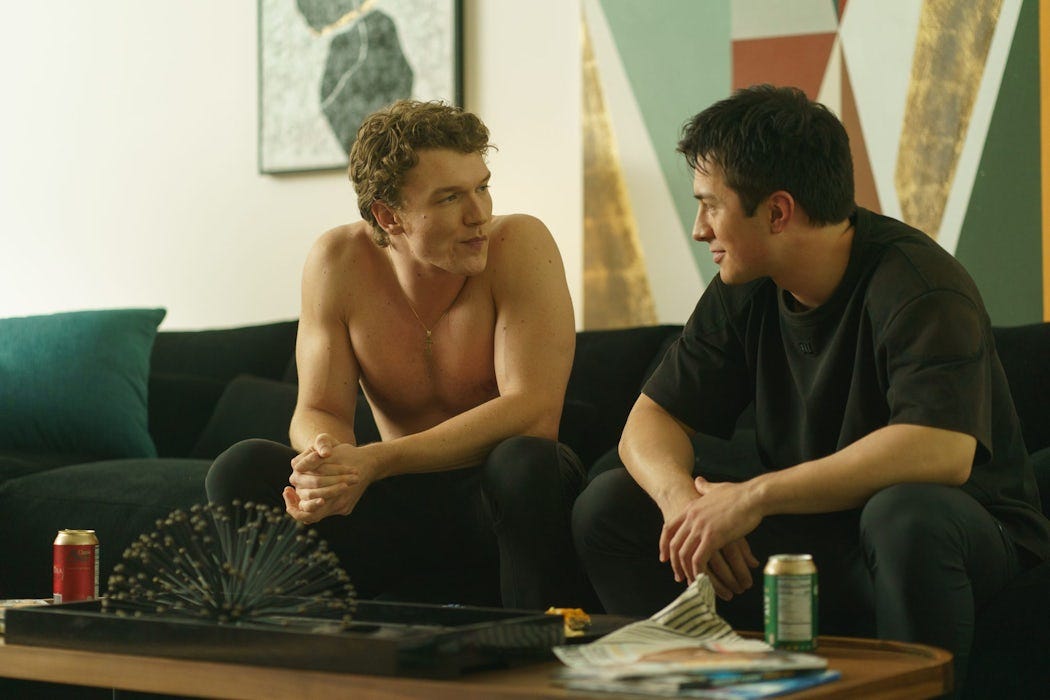
I never imagined that the antidote to watching two years of genocide would be two men fucking their way toward love. I also chose this particular event to be my last collection of words I’ll post in 2025. What a year! What a time to be alive. And what a lesson to arrive at in the closing moments.
For the past two years, I haven’t been able to write about anything beyond the dystopian reality our world has descended into. I’m a cultural writer — I’ve spent nearly fifteen years writing about film, television, and culture — but in the face of the political catastrophe unfolding around us, everything else began to feel trivial, even obscene.
The constant stream of injustice, death, and manufactured narratives consumed all space. There was no room left in me for anything else. Nothing felt worthy of attention while mass suffering played out in real time, normalized and justified before our eyes.
I kept waiting for something, anything, that could pull me out of that paralysis. Something that could cut through the noise, disrupt the despair, and remind me why storytelling still matters. But for a long time, nothing did.
Until Heated Rivalry.
Love as Counter-Programming
Why this series, and why now?
You already know why. Your entire body recognized the truth before your mind caught up. I’m only giving language to what you already felt watching it.
And what we all felt is a godamn rupture!
In a cultural moment shaped by violence and cruelty, the kind of storytelling Heated Rivarly brought to us feels not just rare, but defiant — an act of resistance in itself.
In a world currently organized around domination — of land, of bodies, of narratives — watching two people slowly learn how to choose each other is not trivial. In fact, it’s oppositional.
So consider this piece an invitation from me to you, to watch this show, if you haven’t already — not to disengage from what’s happening in the world, but to recalibrate.

To be fair, as a culture and television aficionado who’s truly watched it all, Heated Rivalry didn’t invent the feeling you’re experiencing right now. In fact, it was heavily inspired by Young Royals (as Jacob Tierney himself has admitted to Slate), and both Royals and Rivalry followed the emotional code first cracked by the pioneer — the original Skam (Norway). Heated Rivalry club scene that’s undoing you? Check out that scene in Skam.
What’s happening now with Heated Rivalry is the timing of it.
After witnessing the dystopian reality our world has descended into, we needed a cultural shift — a cultural armageddon — powerful enough to move people, reorder meaning, and lead us back to humanity.
And boy, did we get it.
If you watched Heated Rivalry, you already understand its power. You know. And those of you who haven’t, you may be wondering how I could argue that a TV show could carry any weight in the face of the political catastrophe surrounding us — and why I’d dare suggest it does.
Just watch it, and you’ll see why.
This show is not just joy and pleasure; it’s an emotional counter-programming, it’s a solace, a permission, an emotional refuge. Heated Rivalry is a break in the matrix. In a cultural moment defined by violence and cruelty, the kind of storytelling this show delivers feels not just rare, but defiant — an act of resistance in itself.
Why is this show a groundbreaking television show and a dystopian resistance at this moment? I’ll break it down for you.
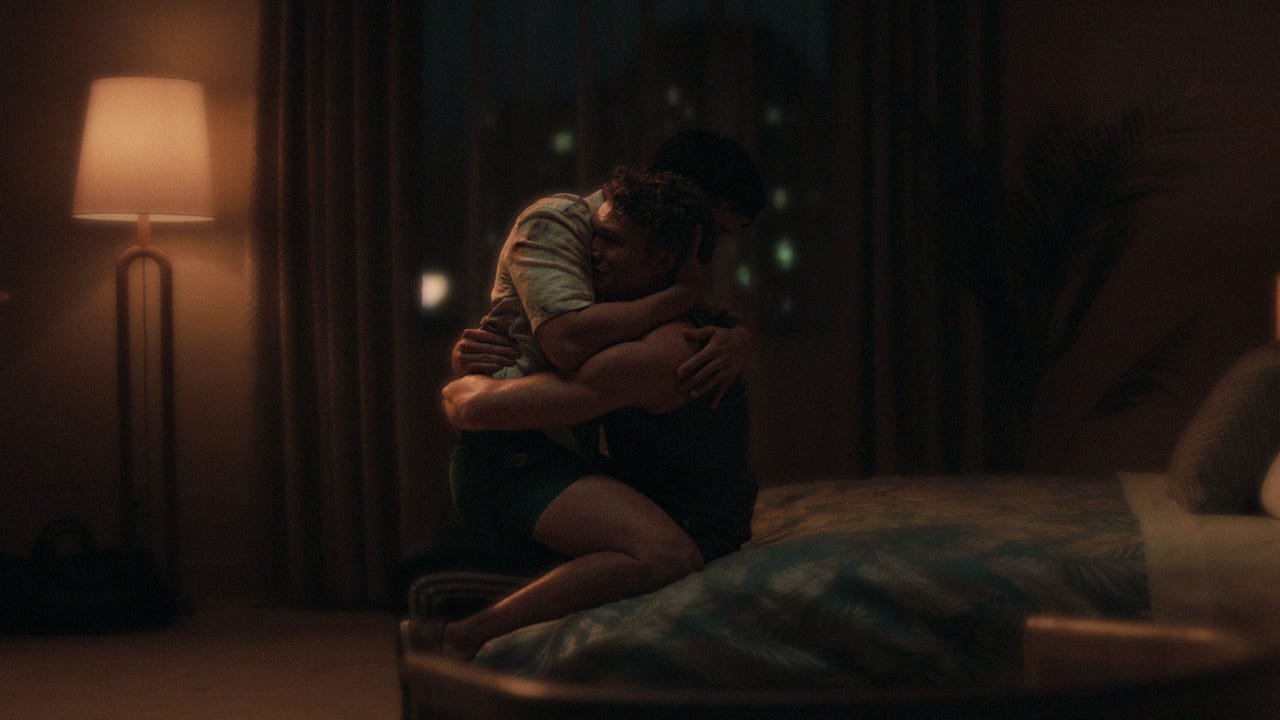
The emotional drought
When I first heard about this show, I didn’t seek to watch it for comfort. I wasn’t in the mood to be softened. I was exhausted, like everyone else, bracing for the next headline confirming how bad things were getting (are).
What caught me off guard wasn’t the mind-blowingly realistic depiction of sex turned into romance. It was the relief of realizing my nervous system hadn’t been lying to me all along — that I still knew the difference between something real and something manufactured.
And let’s be clear, this wasn’t supposed to happen. A low-budget Canadian series, minimal promotion, a queer hockey romance, two leads most people had never heard of — this is not how global phenomena are usually engineered.
And yet it detonated anyway. Across platforms, across borders, across demographics. We weren’t just watching it; we were organizing our days around it, talking about it as if our sanity depended on it.
It isn’t entertainment that’s healing us, but a return inward — to a place we abandoned as violence was normalized and we were taught to look away. This show became a mirror, reminding us that we’re still capable of feeling, and that real storytelling isn’t an escape from reality but a way back into it.
Narrative is the battlefield
We are living in times where almost nothing is anchored to reality anymore. It’s all mostly propaganda and narrative, and that’s not a coincidence.
When narrative becomes the primary tool of power, when our government relies on storytelling to justify violence, normalize cruelty, and manufacture our consent for their idiotic wars, it changes our relationship to stories in all spheres of life.
We are trained to accept shallow, predictable narratives not just in politics, but culture and entertainment as well.
Much of what dominates our screens today isn’t built to tell stories. It’s built to hold attention. Fast, superficial, emotionally thin. Content that is easy to consume and just as easy to forget.
The problem is that when we get used to shallow storytelling, we start accepting shallow explanations everywhere else.
This is why a show like Heated Rivalry feels so different. It doesn’t manipulate emotion or rush through character development. It trusts its audience to pay attention and earn what it gives them.
That’s what makes it feel disruptive. It refuses the assembly line.
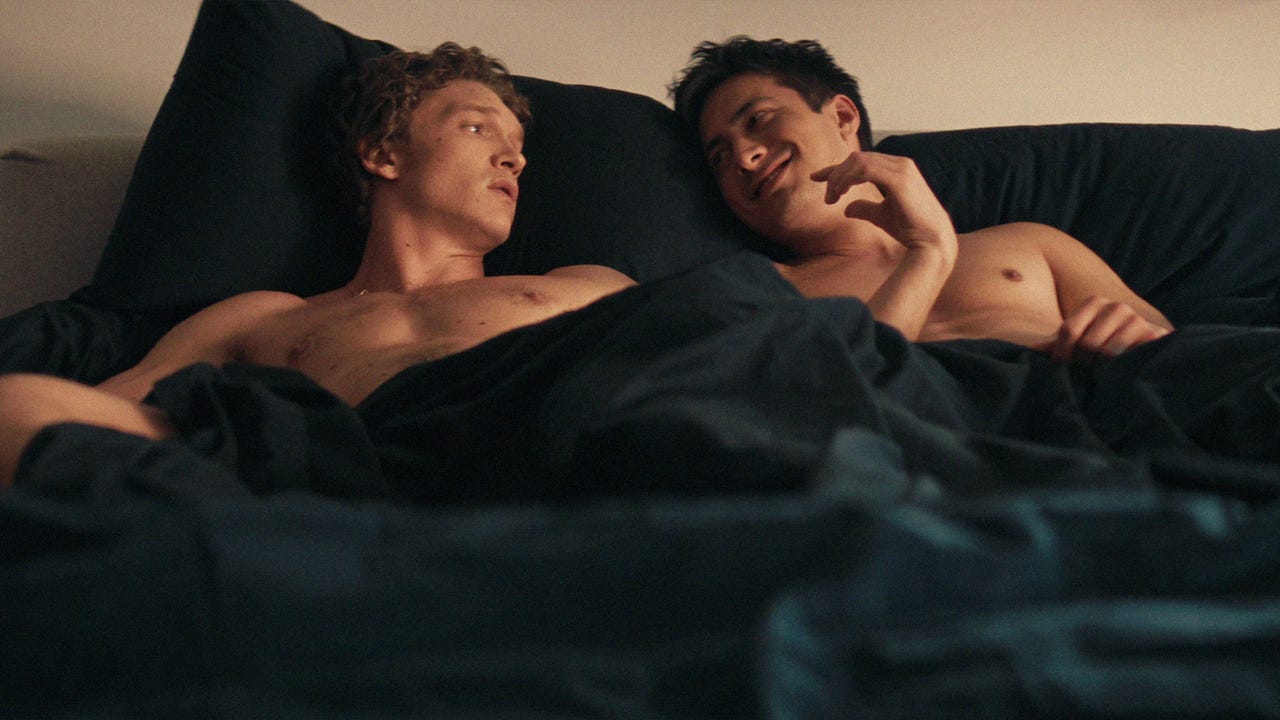
Tenderness as resistance
What many people are starving for right now, even more than romance, is honesty. The sense that actions have consequences, that people are shaped by what they endure, and that connection means something.
Day after day, we’re asked to accept stories that don’t match what we can see with our own eyes. That violence is necessary. That dissent is dangerous. That empathy is weakness. That obedience is patriotism.
Against that backdrop, Heated Rivalry feels different. It doesn’t tell viewers what to think. It simply shows people struggling, changing, making mistakes, and finding their way toward each other.
In a culture saturated with performance, propaganda, and distraction, spending time with something honest is not a retreat from reality. It is a reminder of what reality looks like.
Identity as constraint
What distinguishes Heated Rivalry from most romance-driven television right now is its refusal to condescend — emotionally, intellectually, or narratively. The show understands that physical attraction is not the story; what people do with it is. The conflict doesn’t come from forced drama, but from the gap between what people want and the world they live in.
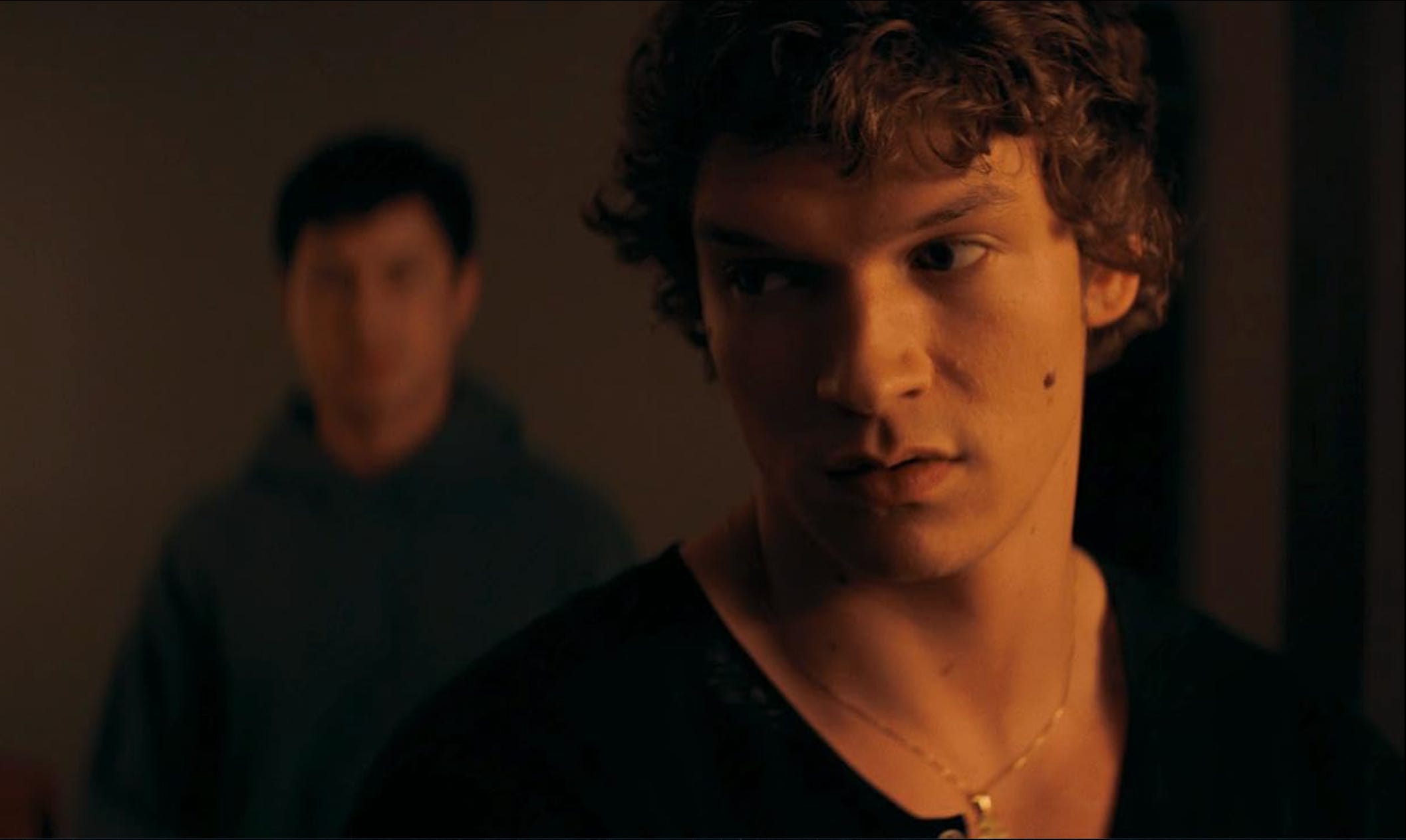
That friction is especially visible in Ilya. His Russianness is not a character trait added for flavor. It shapes how he moves through the world. His nonchalance, provocation, and emotional distance don’t feel like tropes. They feel like habits built over a lifetime of protecting himself.
His evolution is neither linear nor idealized. He moves forward, falls back, and contradicts himself. He behaves like a real person trying to navigate complicated circumstances.
Perhaps the most striking achievement of Heated Rivalry is that it feels neither idealized nor cynical. It doesn’t sell a fantasy, but it doesn’t sink into despair either. The show understands that love doesn’t erase problems. It exists alongside them. Here, love is difficult, destabilizing, occasionally inconvenient, and painfully real.
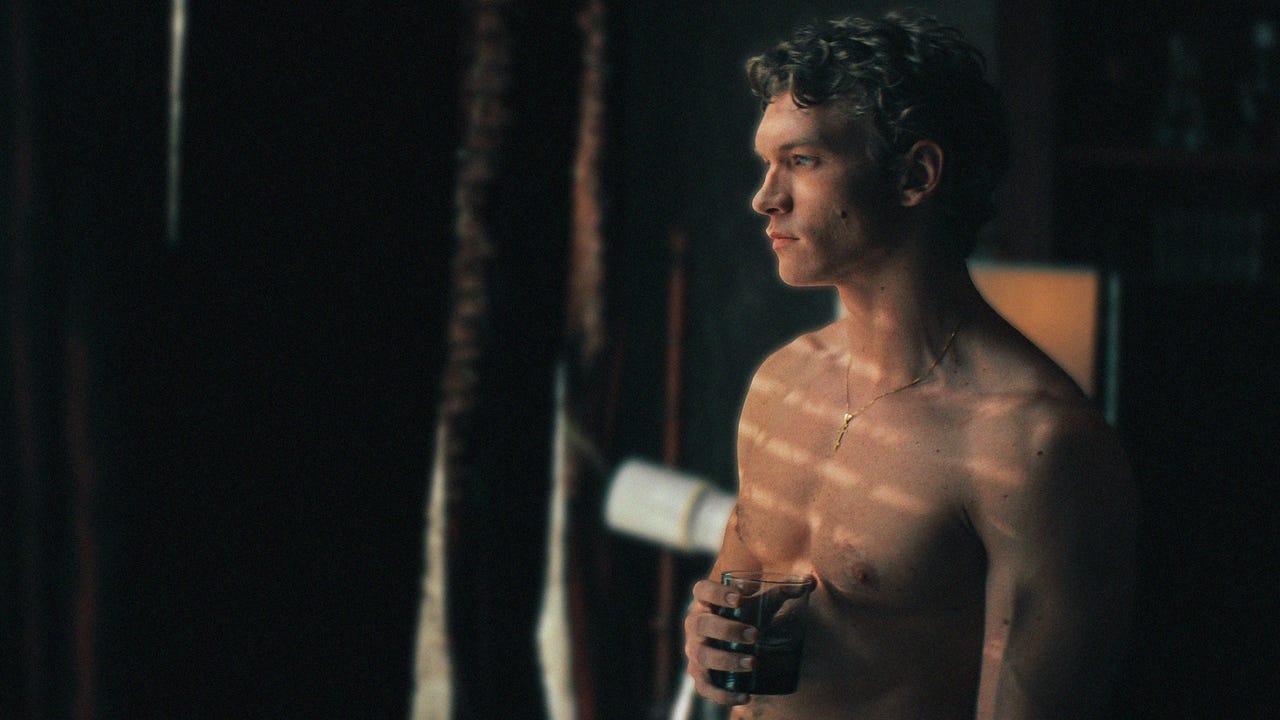
Immigration, belonging, and the cost of existing
What further sharpens Heated Rivalry is something the series never announces, but constantly understands: Ilya is an immigrant.
In a climate where immigration is reduced to slogans, political talking points, and fear campaigns, that matters. Ilya does not move through the world as someone whose belonging is automatically assumed. Every risk he takes carries a different weight because he knows his place is conditional in ways other people’s often are not.
His caution never feels like paranoia, and his restraint never feels irrational. The show understands that being an immigrant is not just a legal category. It shapes how you move through the world, what risks you are willing to take, and how much you stand to lose if things go wrong.
What makes this especially powerful is that Heated Rivalry never turns Ilya into a symbol or a lesson. He remains a fully realized person whose experiences shape him without defining him. By placing an immigrant at the emotional center of the story, the show reminds us that belonging is about far more than paperwork. It is about being seen, accepted, and allowed to build a life without constantly having to prove you deserve to be there.
The permanent in-between
What Heated Rivalry captures with unusual precision is not just Ilya’s status as an immigrant, but the emotional cost of being one.
He is in North America because his work demands it. His talent requires displacement, but displacement is never neutral. It separates people from their families, histories, and the lives they would have lived had they stayed.
While Ilya builds a career thousands of miles from home, life continues without him. Parents age, people get sick, time passes. When his father dies in Russia while Ilya is in Montreal, grief and guilt become inseparable. He wasn’t there because he couldn’t be. But that rarely makes the guilt disappear.
Many immigrants live with this fear constantly: that something will happen back home and they will arrive too late—or not at all. That success will always come with a cost.
What makes this even harder is that, over time, you stop fully belonging in either place. You remain foreign where you arrive, but you also become distant from the place you left. Years pass. Shared experiences are missed. The gap quietly widens.
That sense of distance shapes everything about Ilya. He has friends, teammates, status, and success, yet there is a loneliness beneath it all. His caution, emotional restraint, and instinct to create distance feel less like personality flaws and more like the habits of someone who has spent his life calculating risk. Even intimacy carries different stakes for him.
For Ilya, Shane is a risk at first. Over time, he becomes a refuge.
Heated Rivalry never spells any of this out. It simply trusts viewers to see it. That trust is why this story works.
Sex as character development
One of the smartest choices Heated Rivalry makes is refusing to play Hollywood’s favorite game: three seasons of yearning before a first kiss, treating sex as the finish line.
Much of television relies on the same formula — stretch the tension for as long as possible, delay intimacy with illogical plotlines, and use the first kiss or first sex scene as the payoff. The relationship becomes a puzzle designed to keep viewers watching.
Heated Rivalry, thank dear lord, takes a different approach. Shane and Ilya sleep together immediately. There is no will they or won’t they. They will. The question is never whether they want each other. They do.
Instead of using sex as a reward (yawn), the series uses it as character development. Every encounter reveals something new about who these men are, what they fear, what they need, and what they are unwilling to admit. As their feelings develop, the physical intimacy changes with them. What begins as attraction gradually becomes trust, vulnerability, dependence, and eventually love.
This is why the intimacy never feels gratuitous. The sex scenes are doing narrative work. They move the relationship forward, reveal each character, and expose emotional truths that neither man is (yet) capable of saying out loud.
In a culture that has become strangely uncomfortable with desire, Heated Rivalry treats intimacy as a normal part of being human. Not something to be hidden, apologized for, or saved for a season finale.
The result is a love story that feels so honest, we all felt like we were part of it.
Crowdsourced fame
This is my favorite part of the Heated Rivalry phenomenon. While Connor Storrie and Hudson Williams did wait tables for eight years before hitting it big with the show, they did not suffer for fame. They weren’t a part of Hollywood; they were on the outskirts of it.
They didn’t have to deal with the moral rot of Hollywood. The internet took one look at them, and I mean one look, and decided they are the new superstars. PR offices didn’t make them. People did. In fact, these two boys auditioned for almost a decade, and no corporate office decided they were superstar material. People did.
They don't have industry connections, and they aren't nepo babies. People made them. Their success is proof that fame and stardom can now be crowdsourced. And you better believe that's a kind of democracy the entertainment industry doesn't want becoming a habit.
Hollywood hates being cut out of the fame pipeline.
Permission to Breathe
It’s okay to rewatch this show over and over again.
It is okay to rest your eyes.
It is okay to let your nervous system unclench.
It is okay to watch something that reminds you why preserving humanity matters in the first place.
The goal was never to endure endlessly.
The goal was to remain human.
And sometimes, humanity looks like a mind-blowingly realistic, well-told love story, uncorrupted by Hollywood, quietly reminding us that another emotional language is still possible.
