
We Need Artists Who Aren’t Afraid of Politics
Art does not merely reflect the world. It helps build it.

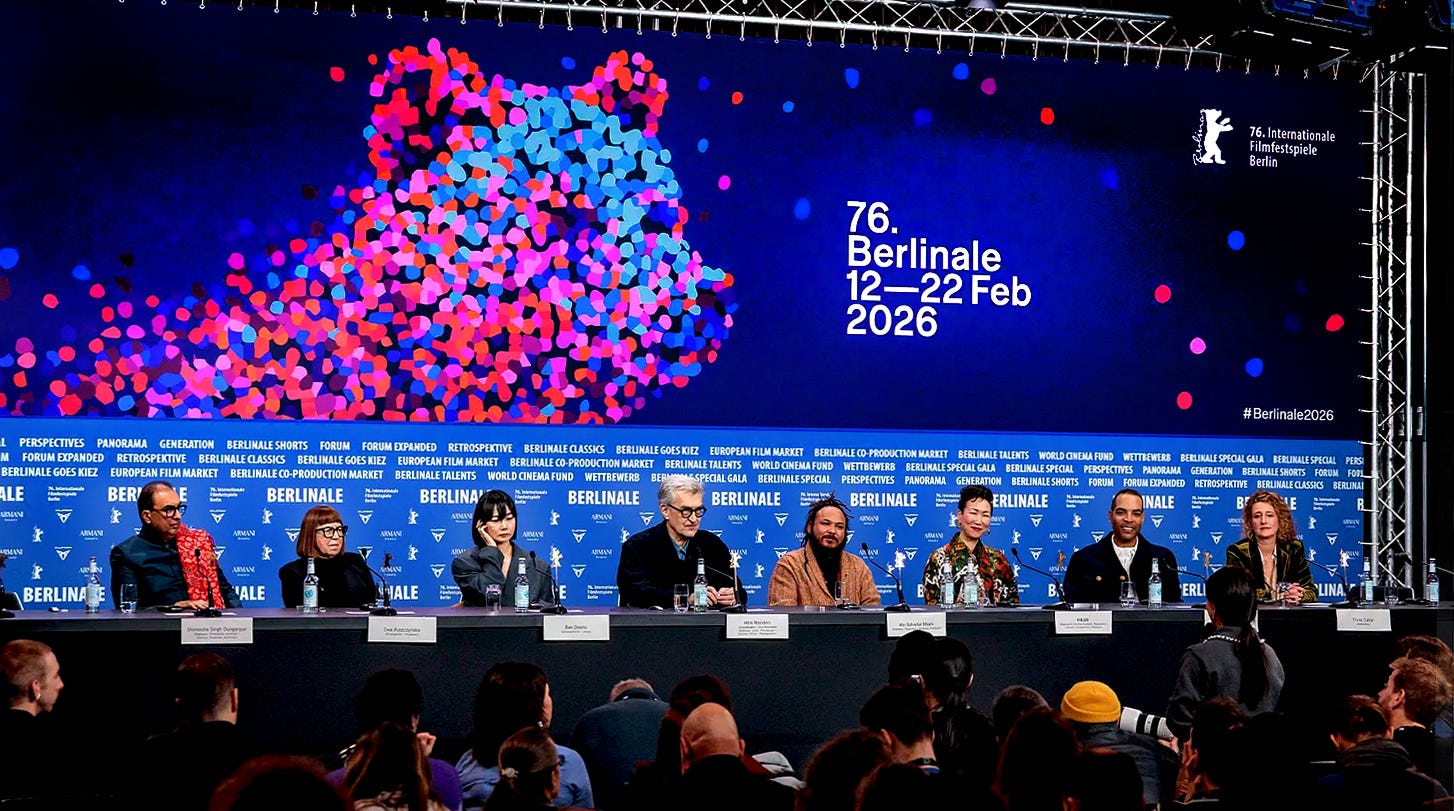
The Berlinale stage is not a neutral living room. It’s one of the most visible cultural platforms in the world, where silence is not accidental. Also, a tiny reminder — there is no such thing as “apolitical art.”
Every film, every performance, every red-carpet moment, every acceptance speech carries the fingerprints of the political world that produced it.
This year’s Berlin Film Festival is a parade of spineless, apolitical cowards posing as artists. It’s hard to comprehend the pile of nonsense that came out of so many mouths over the past couple of days.
Being an artist, standing on one of the world’s largest stages, at one of the most political festivals, backed by a government funding an ongoing genocide — while living through deadly ICE protests in the U.S., the Epstein scandal, a livestreamed genocide in Gaza, genocide in Sudan, human rights violations and sexual violence in Congo, and the rise of fascism in the UK, the U.S., and Germany — and then declare, “I choose to keep my work apolitical.”
As if that were possible.
As if culture floats above power.
As if silence is neutral.
Cowards.
At the press conference for filmmaker George Jaques’ Sunny Dancer, Bella Ramsey and Neil Patrick Harris were asked by a journalist whether they consider their “art to be political, and if so, how can movies these days help fight the rise of fascism in Europe and in America.”
Neil Patrick Harris: “I think we live in a strangely algorithmic and divided world right now. And so as artists, I’m always interested in doing things that are apolitical, because we’re all as humans wanting to connect in some way. That’s why we experience things together.”
George Jaques: “I think sometimes the most rebellious thing you can do is be optimistic. And we wanted to make a film about joy. I think, you know, there’s so much going on in the world right now, and I wanted to make something that really takes you somewhere else.”
Bella Ramsey: “Sunny Dancer was honestly, like, the best experience I’ve had in my career so far. It will be very hard to top. It’s a big statement, but it was probably the best professional six weeks, and also one of the best personal six weeks, of my frickin’ life.”
Journalists at the Sunny Dancer presser, bless their souls, wouldn’t be deterred. A writer from German broadcaster ZDF asked Harris, as a U.S. citizen, whether he “dared criticize the U.S. government and whether he believes democracy is in danger in the U.S.” The Berlinale moderator then interjected that the question “wasn’t relevant to Sunny Dancer.”
Neil Patrick Harris added he would rather discuss the film, saying: “I make my own choices as a performer, as an artist … I feel more the jester in the castle. So while I have my own political opinions, which are my own, I think as a performer, especially in this kind of movie, it’s trying to be as inclusive as possible to as many people as possible. So I never read this script as a political statement.”
The journalist from ARD broadcaster responded: “It’s embarrassing to say the film isn’t political. Without proper health insurance, I wouldn’t be here. I had cancer myself. So the film is political, and this festival must be political.”
Heroes.
Unlike Ethan Hawke, who just a few days ago said, “Anything that fights fascism, I’m all for it, fascism is on the rise in Europe and the U.S.,” but at the Berlinale stage, where it mattered, resorted to: "I feel like there's a slight agenda to your question that is different to my agenda. But I respect you and I respect the question."
At his press conference, Rupert Grint explained he’s against fascism, but the biggest festival stage on earth is not the moment where he thinks he should talk about it, then said: “Obviously, I’m against it. But I choose my moments when to speak.”
During her press conference, Michele Yeoh chose to say: “I don’t think I am in the position to really talk about the political situation in the U.S., and also I cannot presume to say I understand how it is," she said. "So, best not to talk about something I don’t know about. I think I want to concentrate on what is important for us, which is cinema.”
Jury.
Jury president Wim Wenders, producer Ewa Puszczyńska, and festival director Tricia Tuttle gave the most embarrassing examples of artists pretending art is apolitical for their own comfort.
At the opening jury press conference, the live feed cut out as a German journalist asked a question about why Berlinale had shown support for people in Iran and Ukraine, but never for Palestine, a fitting disruption for a festival in a country whose government is funding that genocide while beating and imprisoning its own citizens for protesting it:
“My question is, in light of the German government’s support of the genocide in Gaza and its role as the main funder of the Berlinale, do you, as a member of the jury, support this selective treatment of human rights?”
At this moment, the live feed went down, cutting the live broadcast in the middle of a journalist's question.
The answer that came from Ewa Puszczyńska, the producer of Cold War and The Zone of Interest, two films about war and genocide, was the most shocking:
“Asking us this question is a little bit unfair… we use the word ‘change the world’ but we are trying to talk to people, every single viewer, and to make them think, but we cannot be responsible for what their decision would be to support Israel … to support Palestine.
We can talk about Senegal and all the other wars, you know, you just pointed [to] the most, the biggest, but there are many other wars where genocide is committed and we do not talk about that. So this is very complicated questions … And I think, as I said, it’s a bit unfair asking us what we think, how we support, or not support, or are talking to our governments or not.”
“I’m speaking for myself I go to elections. I go, I vote using my right as a citizen of Poland, as a citizen of Europe, of the world. I go to marches, I support causes which I think I should support. But all of us here may have other things and take other decisions. So I think asking us these questions and expecting the general kind of answer is not fair.”
Jury president Wim Wenders also attempted to shut down the question about genocide and human rights, saying:
“We cannot really enter the field of politics. We have to stay out of politics because if we made movies that are dedicatedly political, we enter the field of politics … We are the counterweight of politics, the opposite of politics, we have to do the work of people — not the work of politicians.”
The myth of the apolitical artist.
For decades, artists have been allowed to position themselves as “just storytellers.” As if storytelling does not define who is human, who is a villain, and who is disposable.
Art has always legitimized power, challenged power, normalized violence, built empathy, erased empathy, shaped national myths, and rehearsed political futures.
The idea of the apolitical artist is a fiction that protects comfort.
When fascism rises, and artists claim neutrality, what they are really protecting is access: to funding, to markets, to institutions, to safety.
Culture precedes policy.
Before laws change, culture shifts. Before a regime consolidates power, stories prepare the ground. Before people accept cruelty, they are taught who deserves it.
Cinema does this. Television does this. Literature does this. Culture trains emotional reflexes long before anyone reads a manifesto.
So when artists on global stages refuse to imagine a better world — refuse even to acknowledge the one unraveling in front of them — they are not staying out of politics. They are participating in it through omission.
Platforms carry responsibility.
Berlinale is not a private dinner conversation. It is one of the most significant cultural stages in the world. An actor may say, “I’m here to talk about my film.” But the film exists inside history. The industry exists inside geopolitics. The festival exists inside a political climate.
To pretend otherwise is aesthetic minimalism masquerading as moral restraint.
No one is asking artists to become policy experts.
But to say nothing, in an era openly flirting with authoritarianism, is not humility. It is a refusal to imagine a better world for all.
Art lost its moral force when it lost its nerve.
For years, mainstream art cultivated a tone: aesthetic, poetic, detached, safely humanist. The artist was meant to be visionary but never confrontational. Profound but never implicated. Empathetic but never specific.
This produced a generation of artists who explore trauma but avoid naming perpetrators, depict oppression but refuse to confront authoritarianism, celebrate “humanity” while violence unfolds in real time, and accept awards on global stages while declining to acknowledge the forces shaping the world around them.
Art lost moral teeth when artists were encouraged to stay in the realm of feeling, not responsibility.
But the world changed, and many artists did not.
The artists who matter now are the ones who refuse the fiction.
The artists who resonate today are the ones who understand that storytelling is not decorative. It is formative.
They are willing to connect their work to the world, acknowledge the systems that fund and distribute them, speak clearly about dehumanization, defend democracy without irony, and imagine futures that resist brutality.
Art has always been political — not because it waves slogans, but because it shapes perception. When artists claim neutrality, they misunderstand their own power.
And when they step onto a stage like Berlinale, they are already participating in the cultural architecture of the moment.
The question is not whether art is political. The question is whether artists are willing to admit it.

We live in a world where the separation between culture and politics has collapsed. Culture is politics. Politics is cultural. Narratives shape ideology more effectively than legislation. On a stage as large as Berlinale, refusing to engage is not modesty. It is a choice.

Art is never neutral, and artists are political. Each time you decide whose story to write about, what to direct or what to paint - you’re making a decision about who is important and what matters. It’s bound up in the work and it’s important. When artists step back from that, or pretend that art exists for art’s sake, not as part of world that they are citizens of, they are (frankly) cowards. And cowardice allows the facists to win.