

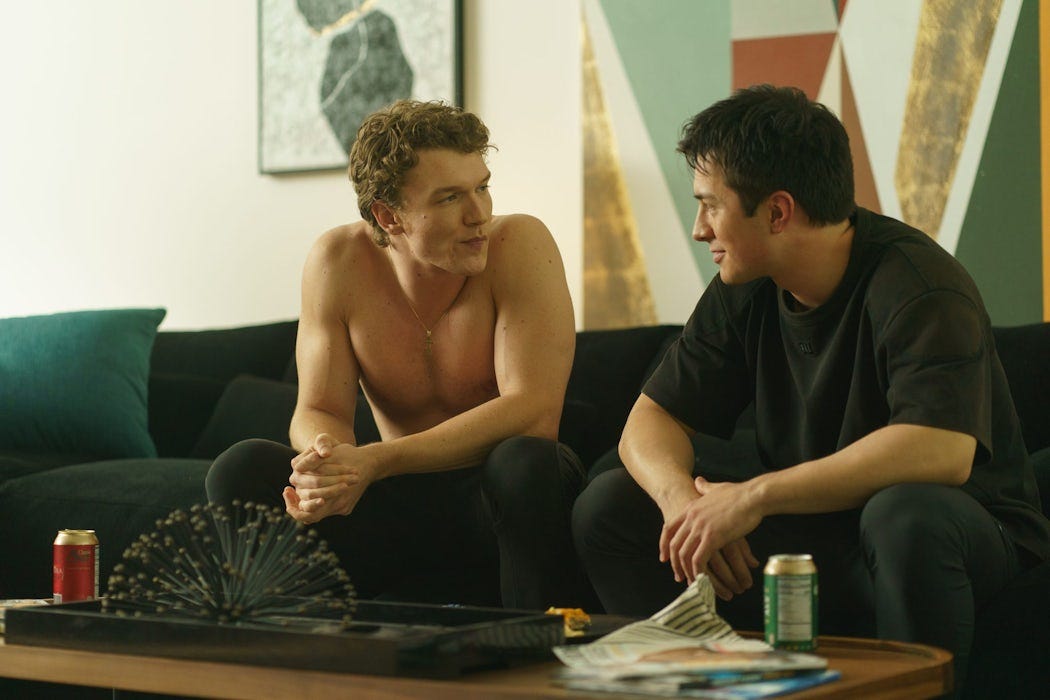
I never imagined that the antidote to watching two years of genocide would be two men fucking their way toward love. I also chose this particular event to be my last collection of words I’ll post in 2025. What a year! What a time to be alive. And what a lesson to arrive at in the closing moments.
For the past two years, I haven’t been able to write about anything beyond the dystopian reality our world has descended into. I’m a cultural writer; I’ve spent nearly fifteen years writing about film, television, and culture, but in the face of the political catastrophe unfolding around us, everything else began to feel trivial, even obscene.
The constant stream of injustice, death, and manufactured narratives consumed all space. There was no room left in me for anything else. Nothing felt worthy of attention while mass suffering played out in real time, normalized and justified before our eyes.
I kept waiting for something, anything, that could pull me out of that paralysis. Something that could cut through the noise, disrupt the despair, and remind me why storytelling still matters. But for a long time, nothing did.
Until Heated Rivalry.
Love as Counter-Programming
Why this series, and why now?
You already know why. Your entire body recognized the truth before your mind caught up. I’m only giving language to what you already felt watching it.
And what we all felt is a goddamn rupture!
In a cultural moment shaped by violence and cruelty, the kind of storytelling Heated Rivarly brought to us feels not just rare but defiant—an act of resistance in itself.
In a world currently organized around domination—of land, of bodies, of narratives—watching two people slowly learn how to choose each other is not trivial. In fact, it’s oppositional.
So consider this piece an invitation from me to you, to watch this show, if you haven’t already—not to disengage from what’s happening in the world, but to recalibrate.

To be fair, as a culture and television aficionado who’s truly watched it all, Heated Rivalry didn’t invent the feeling you’re experiencing right now. In fact, it was heavily inspired by Young Royals (as Jacob Tierney himself has admitted to Slate), and both Royals and Rivalry followed the emotional code first cracked by the pioneer, the shift—an original Skam (Norway). Heated Rivalry club scene that’s undoing you? Skam did it first. Check it out.
What’s happening now with Heated Rivalry is the timing of it.
After witnessing the dystopian reality our world has descended into, we needed a cultural shift, a cultural armageddon, powerful enough to move people, reorder meaning, and lead us back to humanity.
And boy, did we get it.
If you watched Heated Rivalry, you already understand its power. You know. And those of you who haven’t, you may be wondering how I could argue that a TV show could carry any weight in the face of the political catastrophe surrounding us and why I’d dare suggest it does.
Just watch it, and you’ll see why.
This show is not just joy and pleasure; it’s an emotional counter-programming, it’s a solace, a permission, and an emotional refuge. Heated Rivalry is a break in the matrix. In a cultural moment defined by violence and cruelty, the kind of storytelling this show delivers feels not just rare but defiant—an act of resistance in itself.
Why is this show a groundbreaking television show and a dystopian resistance at this moment? I’ll break it down for you.
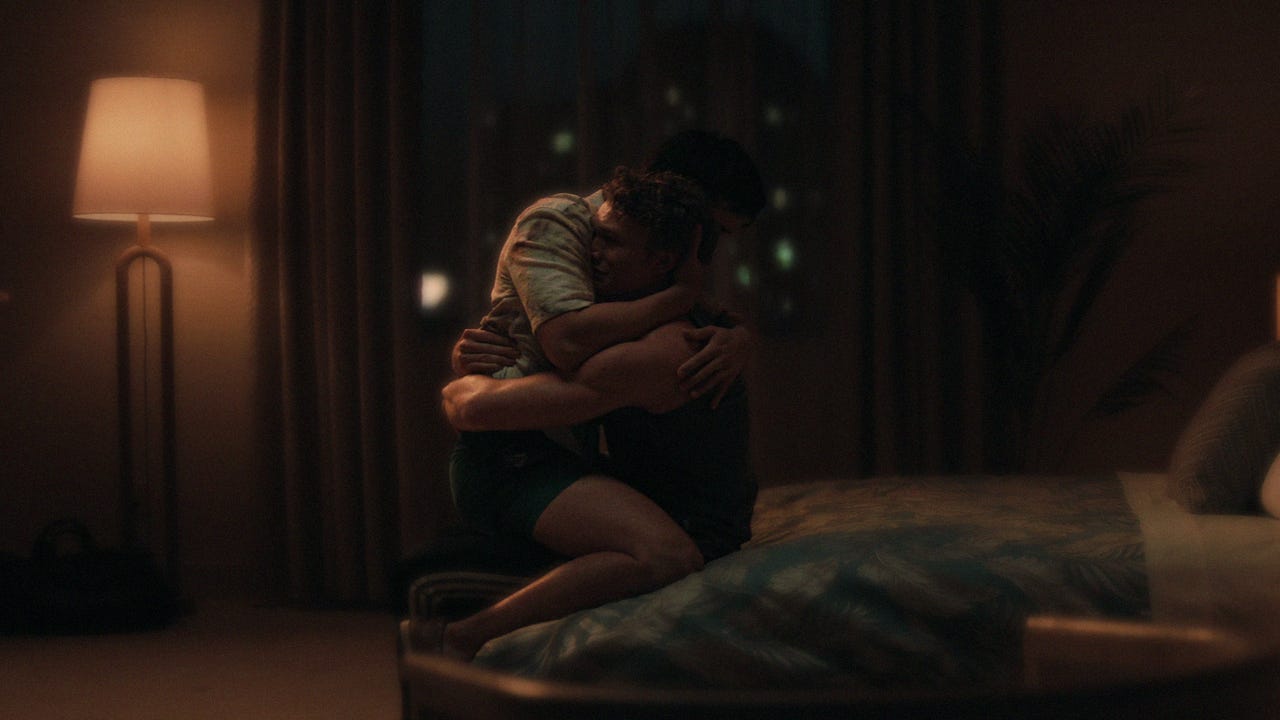
The emotional drought
When I first heard about this show, I didn’t seek to watch it for comfort. I wasn’t in the mood to be softened. I was exhausted, like everyone else, bracing for the next headline confirming how bad things were getting (are).
What caught me off guard wasn’t the mind-blowingly realistic depiction of sex turned into romance. It was the relief of realizing my nervous system hadn’t been lying to me all along, that I still knew the difference between something real and something manufactured.
And let’s be clear, this wasn’t supposed to happen. A low-budget Canadian series, minimal promotion, a queer hockey romance, and two leads most people had never heard of—this is not how global phenomena are usually engineered.
And yet it detonated anyway. Across platforms, across borders, across demographics. We weren’t just watching it; we were organizing our days around it, talking about it as if our sanity depended on it.
It isn’t entertainment that’s healing us, but a return inward, to a place we abandoned as violence was normalized and we were taught to look away. This show became a mirror, reminding us that we’re still capable of feeling and that real storytelling isn’t an escape from reality but a way back into it.
Narrative as the battlefield
We are living in times where almost nothing is anchored to reality anymore. It’s all mostly propaganda and narrative, and that’s not a coincidence.
