
Connor Storrie’s Rise Is a Recalibration
A reminder that truth still seduces, still breathes, still cuts through the noise.

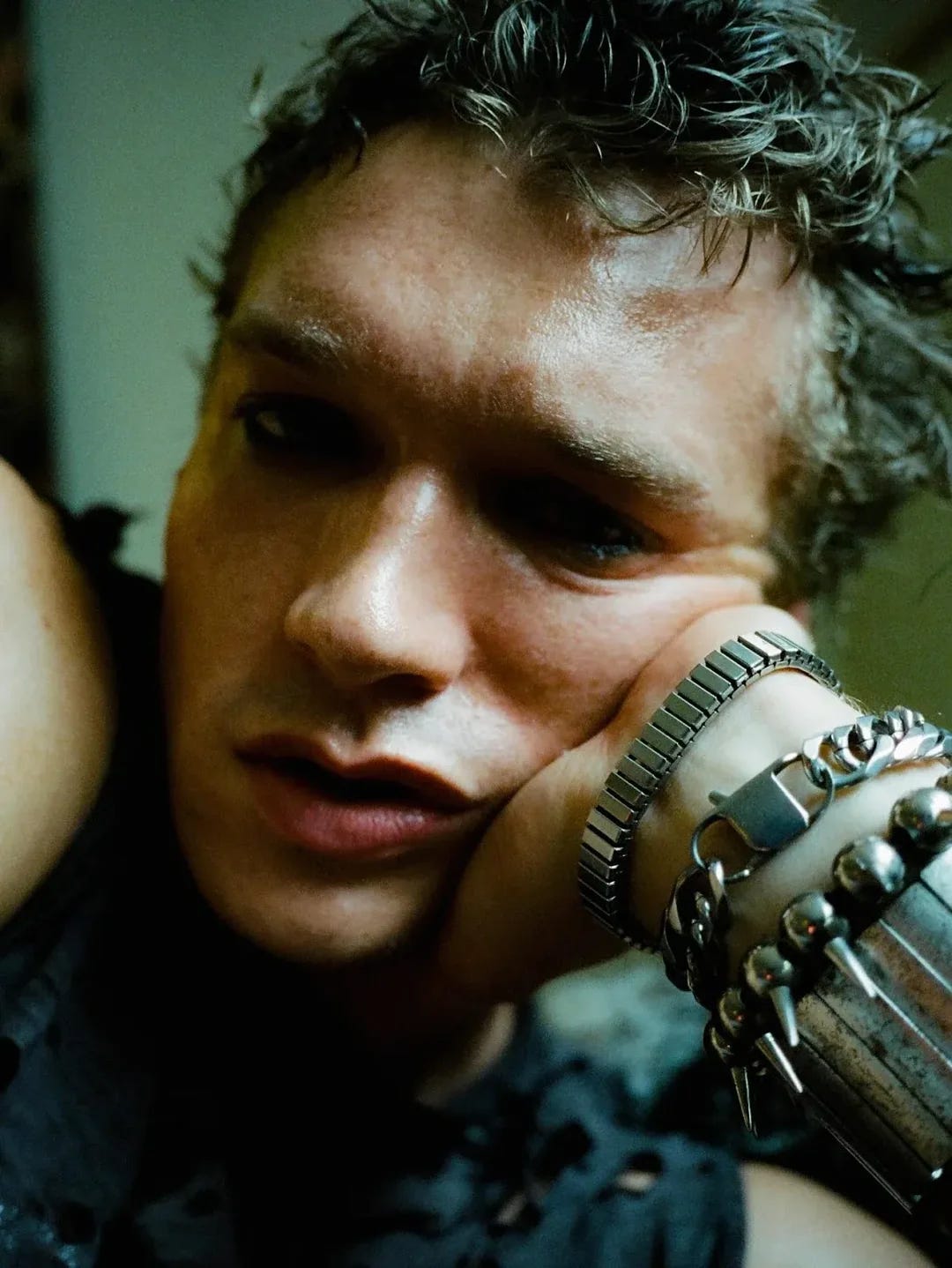
In case you haven’t already figured this out, Hollywood isn’t innocent in creating the dystopian world we live in. In fact, it’s an active participant — a creator, an accomplice, an extended hand.
American arrogance doesn’t stop at geopolitics or failed diplomacy; it seeps into culture, cinema, music, entertainment — into the narratives that teach the world how to perceive power. Hollywood is not simply complicit in the global power structure. It’s one of the most morally corrupt cultural institutions of our time.
In a country overwhelmed by political dysfunction, cultural fragmentation, and ideological chaos, people pointed to an actor. A talent emerged in the American landscape, seemingly out of nowhere, and he made people feel something that felt clean, grounded, and human.
Connor Storrie.
I was scrolling through Threads the other day when I came across a post asking, “Is there one good thing about America?” A surprising number of people gave the same answer: “Connor Storrie.”
It’s silly, in the scope of things — and yet this is where people’s minds went, instantly. It’s a phenomenon, the way everyone is reacting to this guy who appeared out of nowhere and caused a cultural whiplash.
When people who are tired, disillusioned, and emotionally overstimulated by the constant violence their government inflicts at home and abroad look at a newly emerged artist like Connor and say, “There. That feels good. That feels hopeful,” that’s not just a sudden fandom, but a larger impact.

There’s a bigger story here, folks. You might be wondering why we’re talking about actors when the entire world is burning. Here’s the simplest answer I could give you: authenticity now functions as protest.
In a landscape built to numb and monetize, genuine presence destabilizes the control we no longer even notice. But we felt it. When someone like Connor shows up, an artist not shaped by the machine and not born close to power, the audience responds to him because we experience the feeling of finally choosing for ourselves.
And systems of control, cultural or political, have never handled that well.
A shift.
This week in Connor Storrie’s life feels like a marker. He turned 26, he’s featured in VMAN’s Game Changers issue, and he’s hosting SNL on Saturday. It feels like a shift — not just in his life, but in how fame works, how audiences decide, how Hollywood no longer fully controls the narrative.
His rise wasn’t just a breakout. It was a full-on recalibration.
Connor didn’t take the usual road to stardom. He didn’t spend years climbing a gatekept ladder or endure the ritual humiliation phase that so often precedes recognition in Hollywood. Five months ago, he was waiting tables. Now he’s presenting at the Globes, hosting SNL, and likely heading to the Met Gala.
Hollywood didn’t groom him, slow-walk him, or make him pay his dues in public. He skipped the ritual humility tour.
For eight years, casting offices saw him audition and didn’t fully recognize what was there — until Jacob Tierney did. What followed didn’t feel like a studio-manufactured launch. It felt like a spark that the audience caught first.
The industry didn’t manufacture this rise.
We, the audience, did.
And that’s what makes it seismic.
The rise.
I talk about the phenomenon of Connor’s rise with my culture-obsessed friends, often (Husdon too, but in this piece I’m focusing on the American cultural landscape/American actor), and we try to break it down: how did this happen? How did Connor happen?
We’re living in a moment when the systems of power that control the entertainment industry (don’t forget, culture has been historically used to push political agendas, pass policy, and artwash criminal activity) still try to ration visibility. They decide who gets the magazine covers and who stays in supporting roles, who is limited to independent projects, and who is allowed to become a star. But Connor’s rise made something clear: fame is no longer exclusively engineered in conference rooms. It can be crowd-sourced. It can be people-powered. It can happen because millions of viewers collectively say, “No. That one. That’s the one.”
Connor isn’t an industry plant. He isn’t a nepo baby. He’s not the result of some legacy last name sliding open doors. His breakout proved something almost radical in 2026: when talent is undeniable, institutions don’t get to ration recognition anymore. The public can crown a star before Hollywood stamps their approval.
And Hollywood, frankly, now has to catch up to Connor Storrie.
The speed.
Here’s the thing — the speed of Connor’s rise is dramatic, yes. It gives whiplash. It makes headlines. It makes people ask, “Has this ever happened before?” But the speed isn’t the most striking part. After all, this man auditioned for eight years, before Heated Rivalry; it’s unimaginable to me that so many casting directors saw this enormous talent, and decided to pass. A famous decade-long overnight success.
The most striking part is his presence, and it seems to me that we missed this particular kind of presence.
Connor carries a kind of depth and magnetism that feels almost anachronistic. There’s a flavor to him that we associate with a different era — true ’90s movie star energy in a time that rarely produces movie stars anymore. Not influencers. Not franchise placeholders. Actual stars. The kind who make you lean forward towards your screen, and smile stupidly at every image, video, or project announcement of his, instead of scrolling away.
There’s something reminiscent of a River Phoenix lineage in him. Not imitation. Not even a glimpse of cosplay nostalgia. But that same sensitivity. That intensity that pulls you in, but it’s also quiet. The emotional intelligence that doesn’t scream for attention but commands it anyway. River was an experience, and Connor brings out the same feeling. You watch him, and you sense someone who understands interiority — who lives inside the character instead of performing around it.
That’s rare in today’s world of fast-paced technology, social media, and constant information overload. And that rarity is what creates cultural moments.
An intuition.
Connor didn’t just enter Hollywood. He disrupted it. He exposed the gap between institutional gatekeeping and audience intuition. He proved that the public doesn’t need to be told who matters. We know. Sometimes we feel it collectively, long before the industry’s casting offices, which watched a once-in-a-generation talent audition for eight years without recognizing him, suddenly rush to catch up and monetize what the audience already recognized and crowned.
Connor’s rise reminds us that fame doesn’t need to be engineered by PR firms that script every vulnerability and assume they know what the audience wants. It can feel organic and be discovered in real time. It can feel like watching something unfold — not something being carefully rolled out.
That matters. Greatly.
Because when audiences realize they have that kind of power, when they see that their collective recognition can launch someone into global visibility, the entire ecosystem shifts. The hierarchy of power cracks. The myth that only insiders can make stars starts to weaken.
Connor’s story isn’t just about one actor having a meteoric year. It’s about a cultural recalibration. About a public deciding that talent, when it’s undeniable, doesn’t need permission.
And the industry hates this. That’s why they quickly signed him (and Husdon) to CAA and dug their claws into both of them. We changed their rules.
The people decided: This one’s ours.
A recovery.
The last few years rewired us; fame became a product line, art became marketing, even humanity got algorithmic. Every emotion was pre-tested for virality before it reached us. Then Heated Rivalry showed up, uncurated and impossible to brand, and something shifted.
Neither of its stars broke into Hollywood; they broke through it.
And maybe that’s the real story — not the rise itself, but what it revealed about us:
that audiences are starving for something unmanufactured, something that doesn’t reek of sponsorships and media choreography. Something that feels true in the body.
It feels almost like a global recovery.
Sincerity is radical now.
A reminder that truth still seduces, still breathes, still cuts through the noise.
However powerful and all-mighty they are, Hollywood can’t really replicate that. It can only chase it, package it, overexpose it. But Connor and Hudson — at least for now — feel untouched. A moment before commodification. A glimpse of what it once meant to witness a movie star before the system processed them.
They reminded us that not everything beautiful must first be approved. That fame can still belong to instinct. That truth, when uncontained, can reach its audience.
Happy Birthday, Connor.
